Quick summary
- Designer initials are tiny signatures, usually near the rim, under a portrait’s shoulder, or inside a design element.
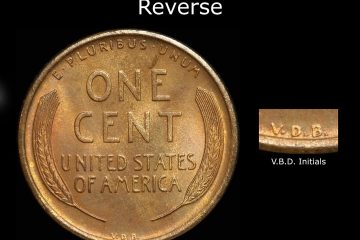
- Victor David Brenner’s V.D.B. appeared at the bottom of the 1909 Lincoln cent’s reverse, was removed after complaints, and returned in 1918 under Lincoln’s shoulder.
- The 1909-S V.D.B. had a mintage under 500,000, compared with almost 30 million from Philadelphia, and is a famous rarity.
- Fakes often put initials in the wrong spot, engrave them too shallowly, or feel too smooth, so check location and detail carefully.
- Heavy circulation wear can erase small initials, and their absence on many dates is normal rather than rare.
Coins are mass produced, but every design begins with an artist, and artists like to sign their work. On U.S. coins, that signature is usually a set of tiny initials tucked along a rim, under a portrait, or inside a wreath. Once you know where to look, finding them takes only a few seconds, and it turns an ordinary coin into a small history lesson. This walkthrough shows you what to look for and where.
Why Engravers Signed Their Work
Every American coin starts with an act of Congress, which sets the theme and requirements for the design. The United States Mint then gathers proposals from two groups: full-time sculptor-engravers on its staff and outside artists in the Artistic Infusion Program. Advisory commissions review the ideas, and the Secretary of the Treasury makes the final pick.
Signing follows a long tradition. For most of the country’s early history, coins carried allegorical images of Lady Liberty rather than real people, partly because George Washington objected that a president’s portrait on coinage would resemble the custom of monarchies. Commemoratives broke that barrier in 1893, and in 1909 Abraham Lincoln became the first real person on a standard-issue circulating U.S. coin.
What You Need Before You Start
- A magnifier in the 5x to 10x range, because initials are often smaller than a grain of rice
- Strong, angled light from a desk lamp or flashlight
- A clean, soft surface to work over, and clean, dry hands
Handle coins by the edges so you do not add fingerprints while you hunt.
Step 1: Look at the Obverse First
The obverse, the side with the main portrait, is the most common spot for a signature. Check the base of the portrait, the shoulder, and the rim near the date. On Lincoln cents made since 1918, Brenner’s initials appear in small letters under Lincoln’s shoulder. Modern designs often follow the same pattern, so the shoulder and the cutoff line of a portrait are the first places to look.
Step 2: Then Check the Reverse
If the obverse is unsigned, turn the coin over. Reverse signatures usually hide near the bottom rim, inside a wreath, or beside a building. The original 1909 Lincoln cent carried V.D.B. at the bottom of the reverse, just above the words ONE CENT. Some designs place initials on one side only, so check both before deciding a coin has no signature.
Step 3: Learn the V.D.B. Story
The most famous initials in American coinage belong to Victor David Brenner, a sculptor and protege of Augustus Saint-Gaudens. His Lincoln cent was released on August 2, 1909, and the large V.D.B. on the reverse drew complaints within days. Newspapers called the initials a blunder, and critics accused Brenner of self-promotion. The Mint removed them from the reverse shortly after the first release.
The story has a collector’s ending. The initials returned in 1918 in much smaller letters on the obverse, where they remain. Careful savers who set aside the original version are the reason so many uncirculated 1909 V.D.B. cents survive. The rare prize is the 1909-S V.D.B. from San Francisco, with a mintage under 500,000 compared with almost 30 million in Philadelphia, making it one of the best-known 20th century rarities.
That rarity belongs to one specific coin, not to wheat pennies in general. Most worn examples bring face value to a modest premium, as we explain in why your wheat penny isn’t worth thousands.
Step 4: Confirm What You Are Seeing
On a 1909 cent, the initials must sit at the bottom of the reverse, above ONE CENT. Initials anywhere else are a red flag. Genuine examples also show deeper, crisper engraving in the letters than most counterfeits, and fakes often have a surface that feels too smooth or a patina that looks wrong for the coin’s age. If something seems off, compare the coin against photos in a reputable reference before spending money.
Step 5: When Wear Has Hidden the Signature
Initials are small and often shallow, so circulation wear erases them early. If you cannot find a signature, try these moves:
- Tilt the coin under a bright lamp so light rakes across the surface at a low angle.
- Rotate it slowly. Shallow engraving can appear and disappear as the light moves.
- Remember that absence can be normal. Cents struck after the 1909 removal have no reverse signature, and that is expected.
Be careful
Do not scrub or polish a coin to make faint initials stand out. Rubbing the surface leaves fine tool marks and an unnatural shine that graders and buyers pick up quickly, and there is no way to bring back the original finish.
To judge how much the wear on your coin matters, our guide to coin grading basics explains how condition is judged in plain terms.
Where Beginners Go Wrong
- Confusing initials with mint marks. These are different kinds of markings that usually sit in different places on a coin, and mixing them up leads to wrong conclusions. The mistakes to avoid when reading mint marks deserve their own checklist, and we cover them at mistakes to avoid when reading mint marks.
- Assuming initials equal value. Most signatures are routine design elements, not signs of rarity.
- Skipping modern coins. Newer designs carry artist signatures too, and practicing on common pocket change builds your eye before you tackle older, scarcer pieces.
Reading designer initials costs nothing and pays off every time you open a roll or a jar of inherited coins. Once you have identified a signature, the next steps are judging condition and authenticity, and our guides to coin grading basics and spotting counterfeit coins cover both.
Collector questions
What does V.D.B. stand for on a penny?
It stands for Victor David Brenner, the sculptor who designed the Lincoln cent. His initials appeared at the bottom of the reverse in 1909 and were moved to a small spot under Lincoln’s shoulder in 1918.
Are coins with designer initials always valuable?
No. Most signatures are a normal part of the design. Value depends on the date, mint mark, mintage, and condition together, and only a few issues like the 1909-S V.D.B. carry large premiums.
My old coin has no initials. Does that mean something is wrong?
Usually not. The Mint removed the initials from the Lincoln cent shortly after its 1909 release and did not restore them until 1918, and wear can erase small initials on any design.
How are initials different from mint marks?
They are different kinds of markings that usually sit in different places on a coin, and mixing them up leads to wrong conclusions. Neither one on its own makes a coin rare.
Coin values change with demand, condition and metal prices. This guide is general information, not an appraisal or investment advice.